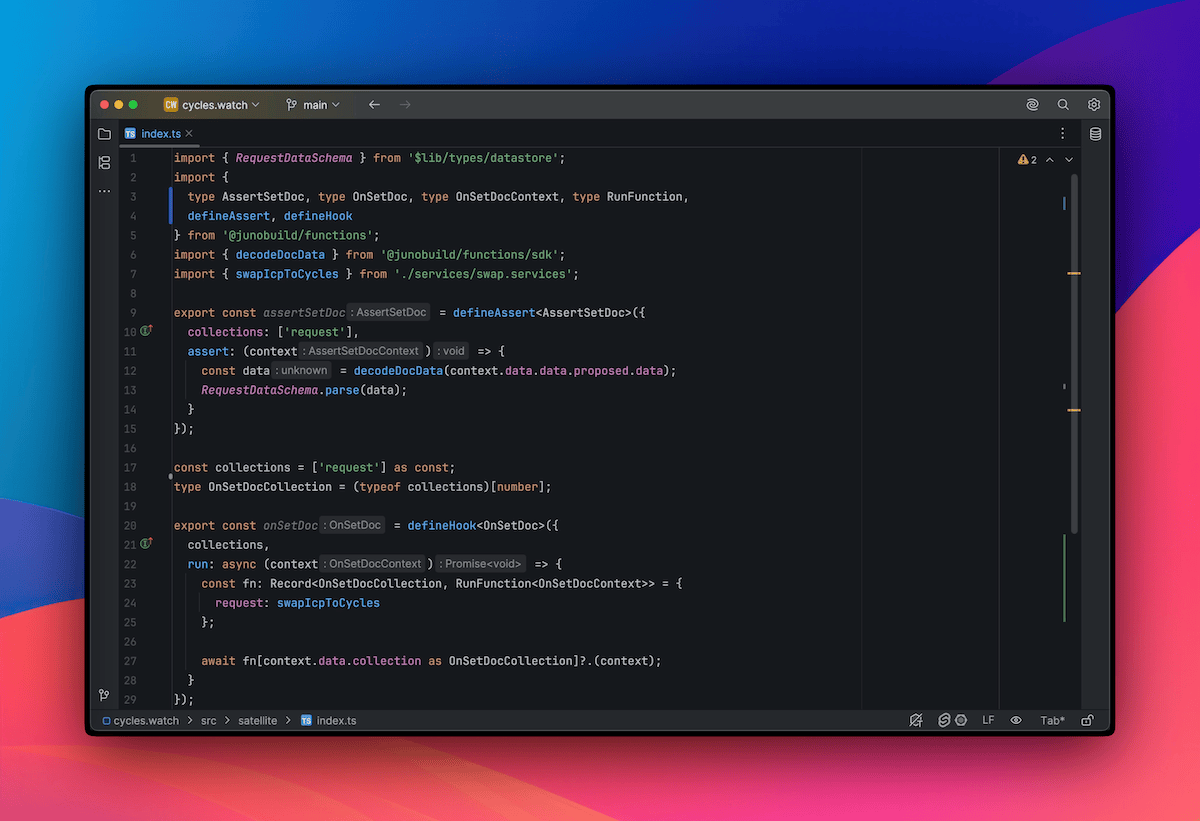
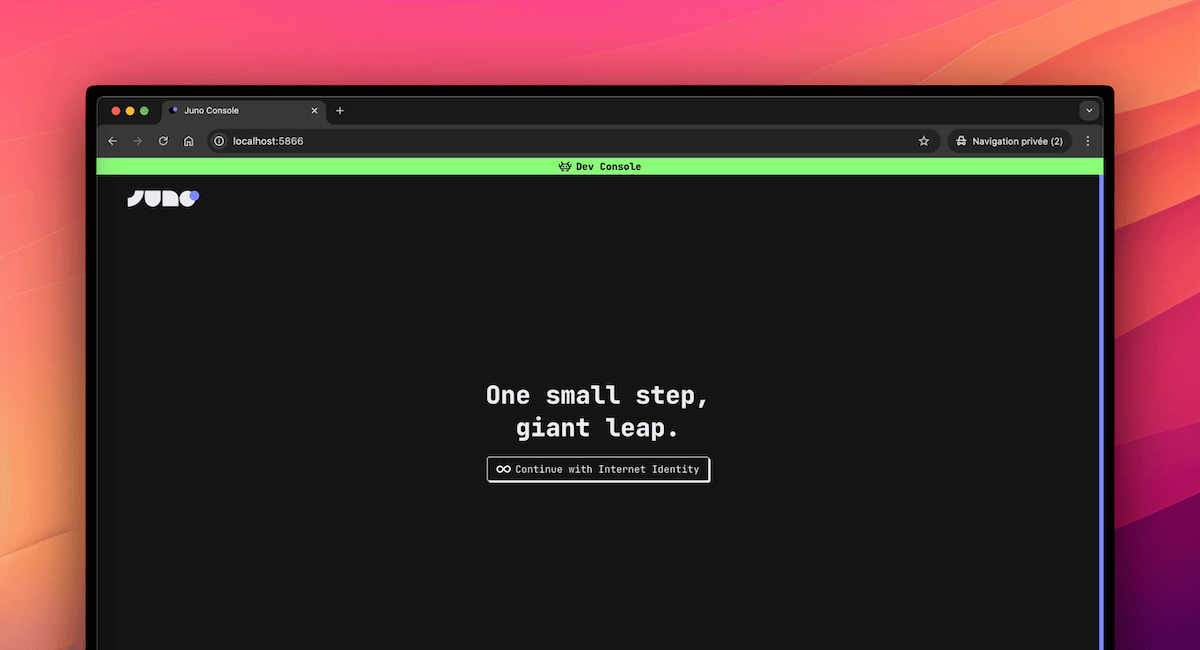
✨ Local dev is now the default for apps (!)
🛠 Scaffold serverless functions
🛰 Sputnik preview (WIP)
📦 Updated all template dependencies
🎓 Onboarding revamped
Morning! Great news for the Juno community, which has always used identity.internetcomputer.org as the default domain for authentication.
Internet Identity now supports passkeys on both of its domains!
This means it should no longer matters whether devs or users sign in via identity.internetcomputer.org or identity.ic0.app — the registered identity should work seamlessly across both. There are a few limitations, which is why II may prompt you to register your current device.
As a result, I’ve just launched a new, clean sign-in page with a single call to action! 🚀
To address potential sign-in issues, the page still offers domain-specific methods as a fallback. Plus, I added a brand-new footer accessible on scroll—kind of really happy with that design. 😃
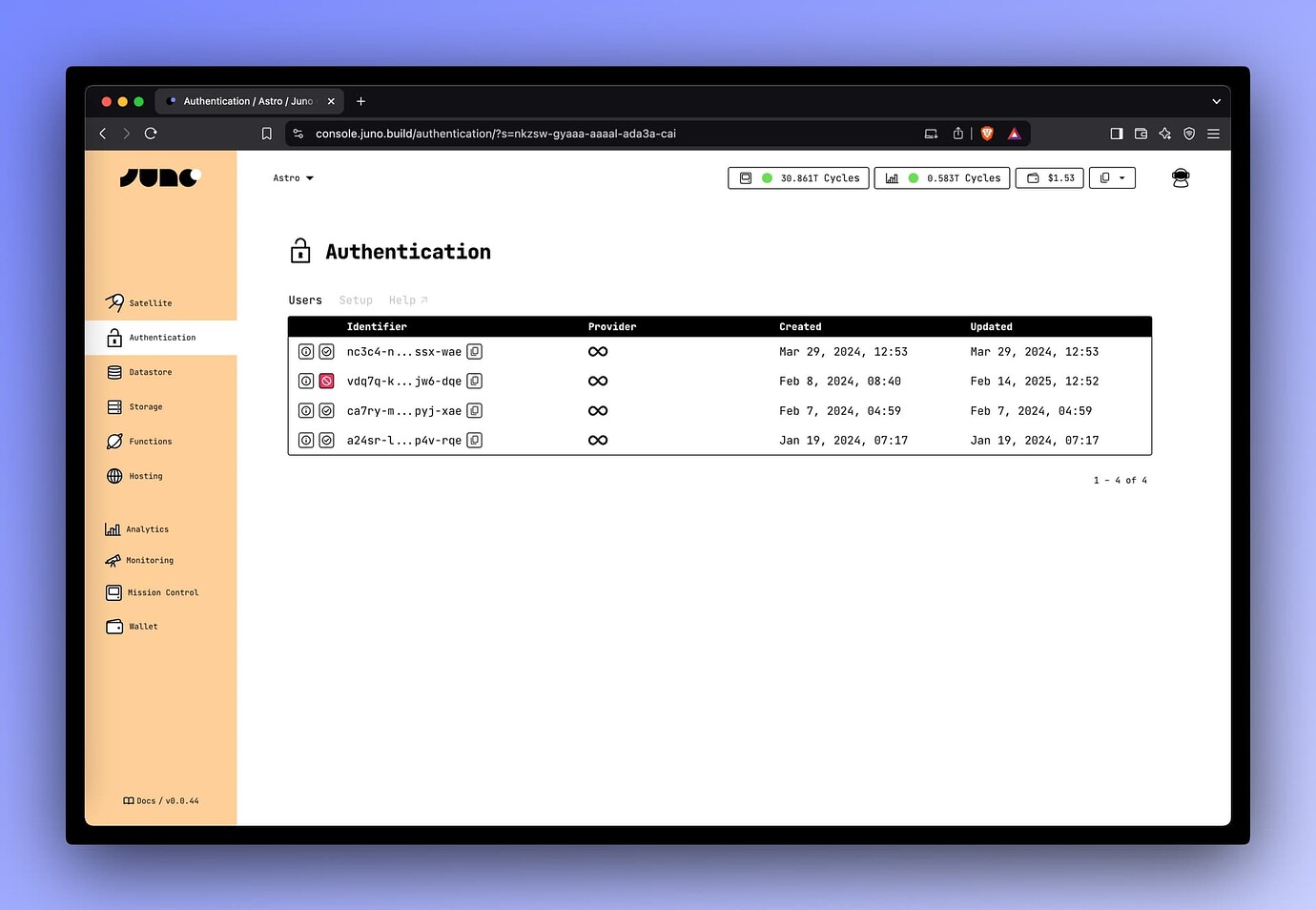
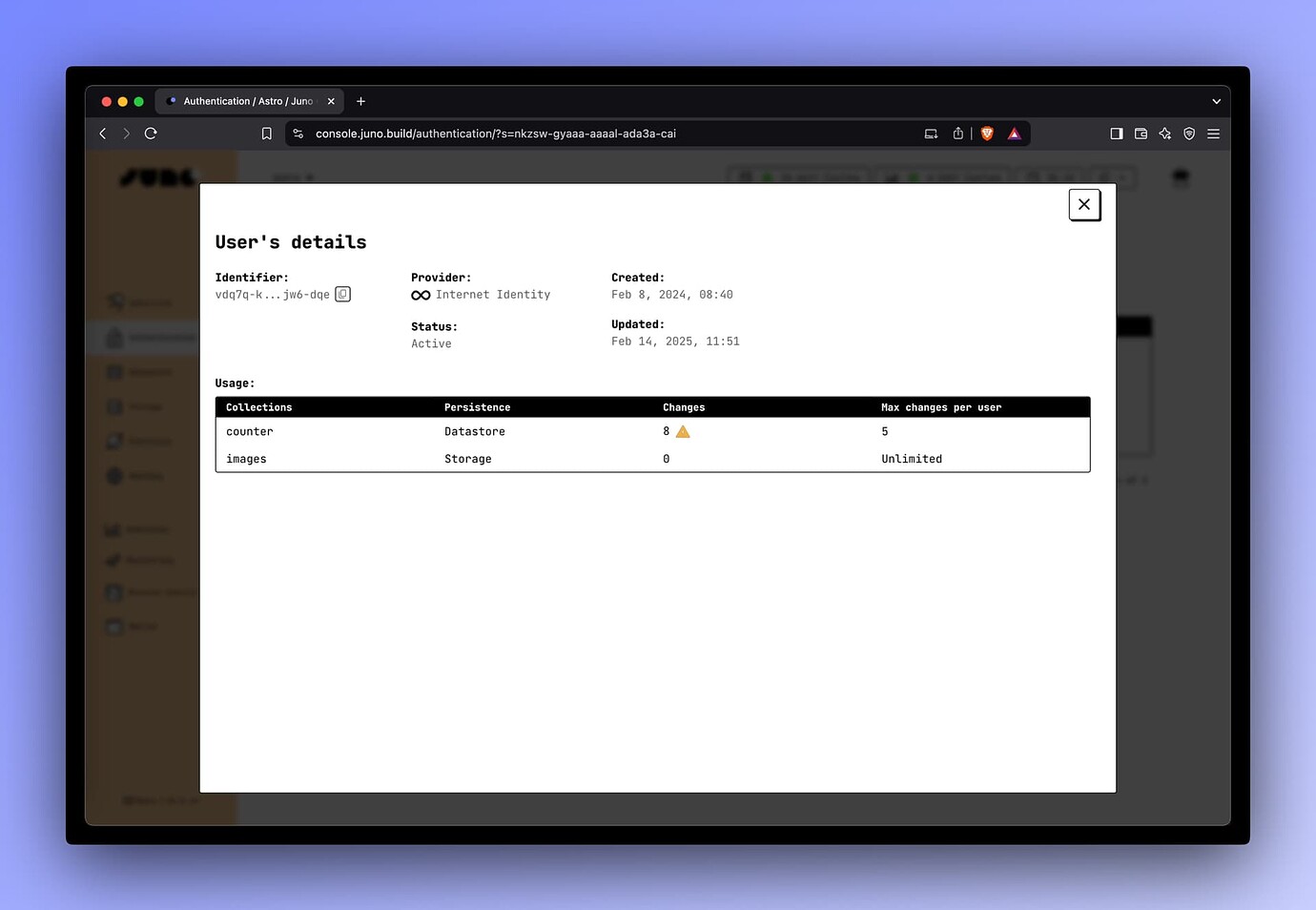
I just published a new version with improvements to user management and scalability:
🔒 Added the ability to set limits on changes per user per collection
🚫 Introduced banning / unbanning users to help prevent misuse
✨ Various enhancements & refinements across the board
Joining the wallet 💵 display party – balances and amounts are now displayed in USD on the Juno Console too! 🎉
Kudos to KongSwap for sharing their exchange rate endpoint! 🙌
While I was at it, I fixed a few navigation leftovers from the last version, reviewed the UX of all transaction modals, integrated the exchange feature into each of them, and... had some fun with the colors 🎨
I’m thrilled to unveil the first big feature of the year: a brand-new way for Juno devs to monitor your wallet and modules automatically! 🚀
✅ Keeps cycles topped up when balances run low
🔔 Sends email notifications for top-ups (opt-in)
🔁 Set it up once, never again — it’s automatically applied to all future projects
Everything is controlled through the Mission Control — which means that developers remain the sole controllers!
🔥 Exciting update! A new feature to automatically monitor your wallet and modules is here! 🚀
✅ Auto-refills cycles when balances run low 📩 Sends email notifications when a top-up occurs
In this version, I also revised the navigation to integrate Analytics, Monitoring, Mission Control, and Wallet within the main panel. This update led to the introduction of new colors. 🎨
November’s been an exciting month, especially since I’ve officially started working full-time on Juno — thanks to the recently announced funding! This shift has already led to delivering some fantastic new features for developers, like automated backups (finally!!!), support for large WASM modules, the ability to buy cycles with Stripe, and a few other goodies.
These updates are all about making development smoother and more efficient, whether you’re building dapps, smart contracts, or managing your projects. Let’s dive into what’s new!
To kick things off, I’d like to highlight the introduction of backups—a feature I’ve been waiting for forever!
This addition brings a crucial layer of security for developers, letting you safeguard your modules and restore them whenever needed.
Here’s how it works: Currently, one backup per module is supported. You can manage backups manually via both the Console UI and the CLI, with options to create, restore, or delete them. Additionally, backups are automatically created during the upgrade process, taking a snapshot before transitioning to a new version. For those who prefer full control, advanced options let you skip creating a backup or avoid overwriting an existing one.
For anyone who, like me, feels a bit tense whenever it’s time to execute an upgrade, this feature is a huge relief. It’s really a great addition!
Getting cycles has become more straightforward, particularly for newcomers and non-crypto-native users, with the ability to buy cycles directly through Stripe, thanks to our friends at cycle.express.
With this integration, developers can simply make a payment, and the cycles are added directly to their module.
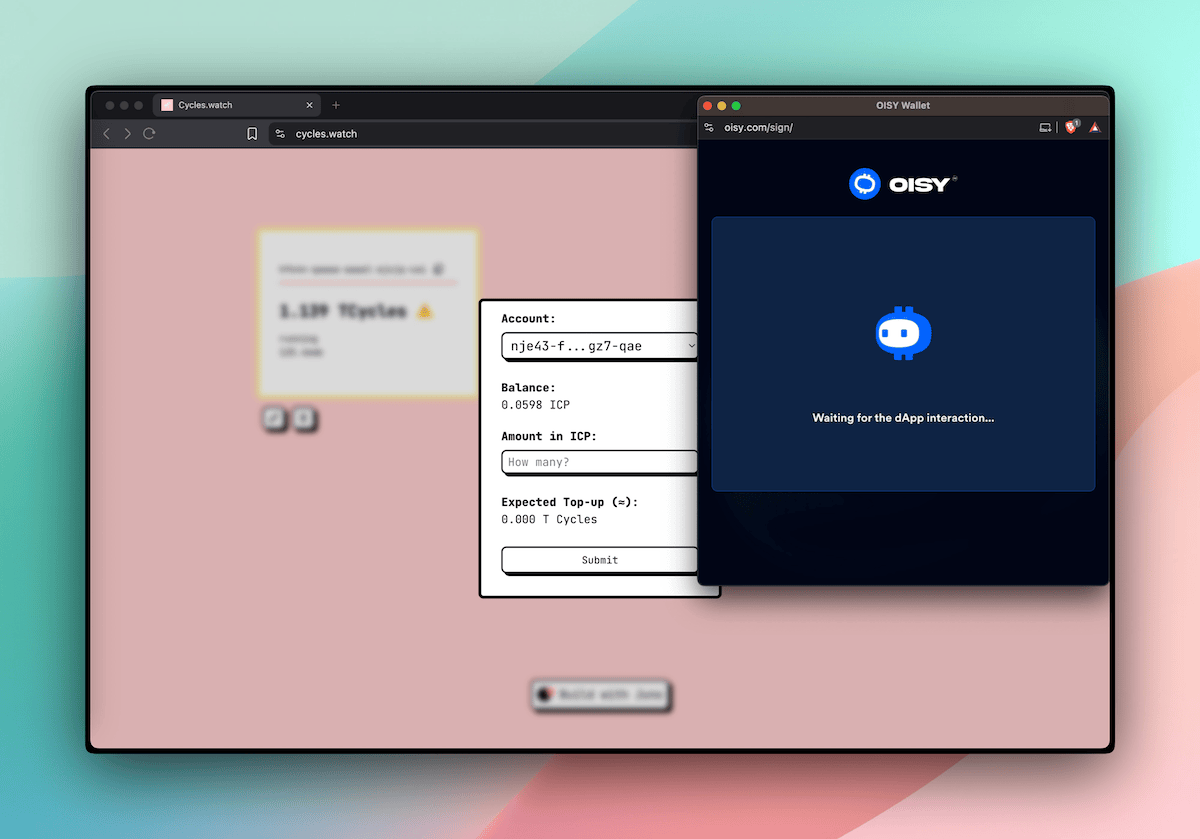
This was both a useful feature, as it makes it easy to transfer ICP from OISY to the developer's wallet on Juno, and an opportunity for me to try out the integration with various ICRC standards I implemented for the foundation.
I also used the opportunity to improve the UI/UX of the Receive feature by displaying wallet addresses with a QR code. This update wraps up a few related tasks, such as adding support for sending ICP to the outside world.
Support for larger WASM modules (over 2MB) has been added. While none of Juno's stock modules—such as Satellites, Mission Control, or Orbiter (Analytics)—come close to this size when gzipped, this limit could quickly be reached by developers using serverless functions.
By extending this limit, developers have more flexibility to embed additional third-party libraries and expand their module capabilities.
This support has been implemented across the CLI, the Console UI, and even local development environments using Docker, ensuring a consistent experience for all workflows.
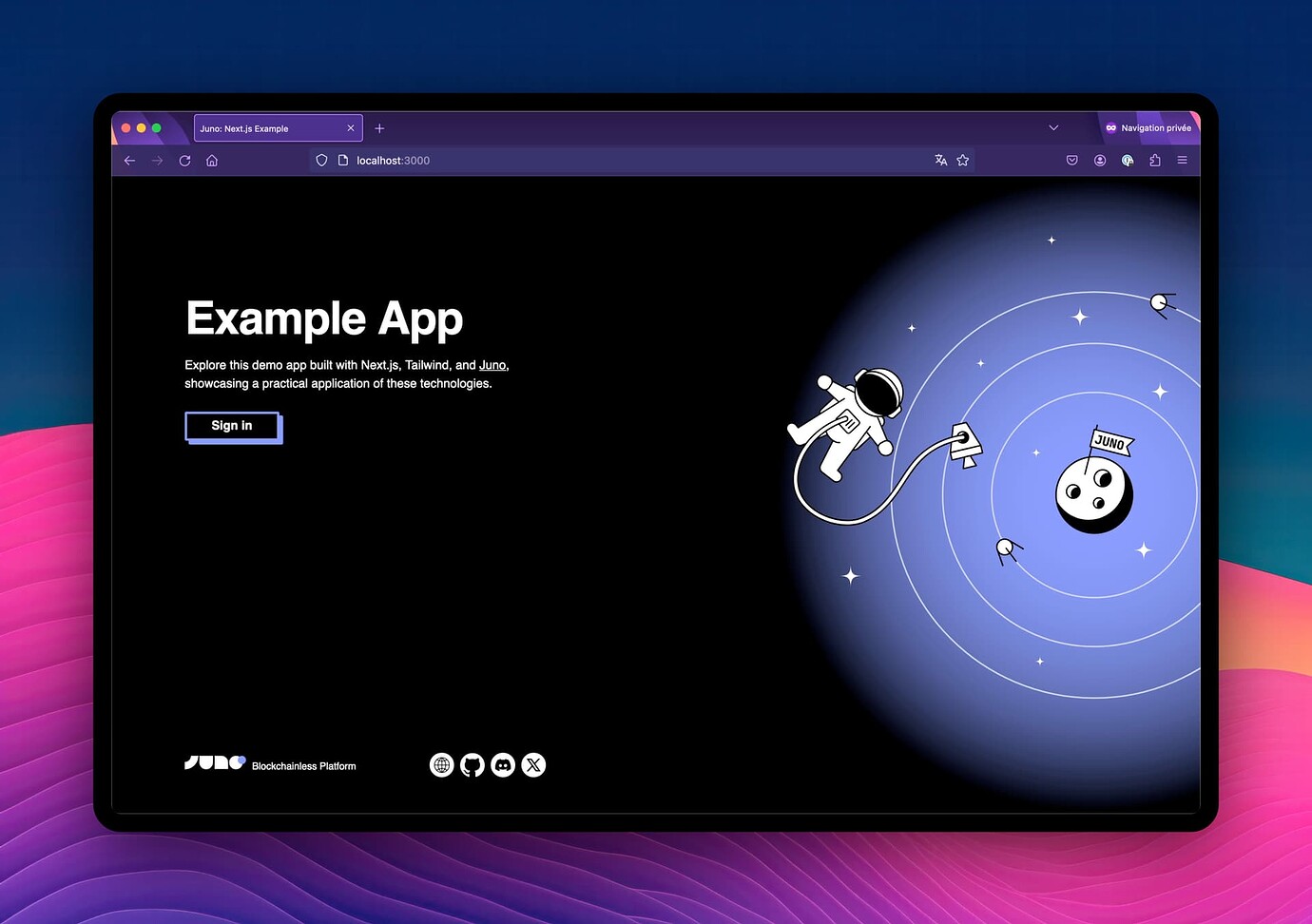
Until recently, new Satellites launched lacked a default page for web hosting. This meant that developers opening their project right after creation would just see a blank page in the browser.
That’s why every new Satellite now comes with a sleek, informative default web page—delivering a great first impression right out of the box! ✨
Another handy tool introduced this month is support for pre- and post-deploy scripts in the CLI. With this feature, developers can now define a list of commands to be executed at specific stages of the deployment process.
The pre-deploy scripts are perfect for automating tasks like:
Compiling assets.
Running tests or linters.
Preparing production-ready files.
Likewise, post-deploy scripts come in handy for follow-up tasks, such as:
Sending notifications or alerts to administrators.
Cleaning up temporary files.
Logging deployment information for auditing.
import{ defineConfig }from"@junobuild/config"; /** @type{import('@junobuild/config').JunoConfig} */ exportdefaultdefineConfig({ satellite:{ id:"ck4tp-aaaaa-aaaaa-abbbb-cai", source:"build", predeploy:["npm run lint","npm run build"], postdeploy:["node hello.mjs"] } });
Maybe not the most groundbreaking update, but the dark theme got even darker. 🧛♂️🦇 Perfect for those late-night coding sessions—or if you just enjoy the vibe!
Another area that saw improvement is the documentation. I aimed to make it more intuitive and useful for both newcomers and experienced developers. That’s why I revamped the guides section. Now, when you visit, you’ll be greeted with a simple question: “What are you looking to do? Build or Host?” 🎯. This approach should hopefully make onboarding smoother and more straightforward for developers.
The CLI documentation also received an upgrade. Updating it manually was a hassle, so I automated the process. Now, CLI help commands generate markdown files that are automatically embedded into the website every week. No more manual updates for me, and it’s always up to date for you! 😄
I also dedicated time to documenting all the configuration options in detail, ensuring every setting is clearly explained.
And as a finishing touch, I refreshed the landing page. 👨🎨
I hope these features get you as excited as they got me! I’m already looking forward to what’s next. Speak soon for more updates!
David
Stay connected with Juno by following us on X/Twitter.
As you may know, I recently proposed transforming Juno into a Decentralized Autonomous Organization through an SNS swap. Unfortunately, it didn’t reach its funding goal, so Juno didn’t become a DAO.
After the failure, three options came to mind: retrying the ICO with a lower target, continuing to hack as an indie project for a while, or simply killing it.
In the days that followed, I also received a few other options, including interest from venture capitalists for potential seed funding which wasn’t an option for me.
Then, something unexpected happened:
The DFINITY foundation’s CTO, Jan Camenisch, reached out and proposed an alternative: funding the project through 2025.
I took a few days to consider the offer and ultimately accepted.
This support is a tremendous vote of confidence in Juno’s potential and importance within the ecosystem.
It’s worth emphasizing that the foundation’s support comes with no strings attached. They do not receive any stake in Juno, have no preferential treatment, and will not influence decisions. Should I ever consider another SNS DAO or any other funding route in the future, the foundation would have no special allocation or shares. This remains my project, and I am the sole decision-maker and controller.
This support also strengthens the relationship between Juno and the foundation, allowing us to stay in close contact to discuss the roadmap. It’s an arrangement that respects autonomy while fostering collaboration to advance the Internet Computer. As they say, it takes two to tango.
This funding opens up a world of possibilities and marks the first time I’ll work 100% on a project I created. I’m thrilled to continue building Juno as a resource that makes decentralized development accessible and impactful for everyone.
Obviously, while Juno remains under my sole ownership for now, I still believe that Juno should eventually become a DAO. Promoting full control for developers while retaining centralized ownership would be paradoxical. When the time is right, a DAO will ensure that Juno’s growth, security, and transparency are upheld through community-driven governance.
Thank you to everyone who believed in Juno through the SNS campaign and beyond 🙏💙. Your support has been invaluable, and this new phase wouldn’t be possible without you. Here’s to what lies ahead—a new chapter indeed.
To infinity and beyond,
David
Stay connected with Juno by following us on X/Twitter.
The SNS DAO on the Internet Computer failed on Saturday, October 12, 2024 (ICP swap data). As a result, Juno did not become a Decentralized Autonomous Organization (DAO).
Hey everyone 👋
I hope you’re all doing well! I’m excited to share some big news with you today. Over the next few weeks, we’re taking some significant steps toward shaping the future of Juno, and I wanted to keep you in the loop about what’s coming.
As you may know, Juno is a blockchain-as-a-service ecosystem that empowers developers to build decentralized apps efficiently. One of its strengths is that it gives developers full and sole control over their work. For this reason, it would be paradoxical to continue operating the platform with a centralized model—i.e., with me being the sole controller of services, such as the administration console or our CDN. That’s why I’m thrilled to unveil that, in the upcoming weeks, I’m aiming to fix this bias by proposing that Juno becomes a Decentralized Autonomous Organization (DAO).
While this potential shift is on the horizon, there are a few key steps you can take to stay informed and involved in the process. Here’s how you can help shape the future of developing on Web3:
To ensure you don’t miss any crucial updates, I encourage you to sign up for our newsletter. The journey to proposing a DAO and making it a reality involves multiple steps, each requiring your participation. By signing up, you’ll receive timely notifications whenever there’s an opportunity to get involved and make a real impact.
The white paper has been updated to continue presenting the vision; however, the tokenomics aspect has been notably removed, as it is no longer relevant following the failure of the SNS DAO.
I’ve put together a white paper that outlines the reasoning and vision I have for a Juno Build DAO. I highly recommend giving it a read to fully understand what I’m aiming to achieve.
Questions are always welcome at any time, but if you’re looking to engage directly, I’ll be hosting a Juno Live session on 9 September at 3:00 PM CET. Join the livestream on YouTube to interact in real-time.
The proposal was approved and executed on September 26, 2024.
While I typically avoid relying on third parties for core features, transforming Juno into a DAO without leveraging such services would be an immense task. That’s why I’m proposing to use the Internet Computer’s built-in solution for creating and maintaining DAOs, known as SNS.
To kickstart the process of transforming our ecosystem, this framework requires submitting a proposal to the Internet Computer’s governance, known as NNS. This step ensures a decentralized and democratic process. It also prepares for the handover of control of the smart contracts and allows all participants to review the parameters involved.
Once this proposal is live, your voice will be crucial! You’ll have the opportunity to vote on whether to accept or reject it.
Please note that the following does not constitute financial advice.
If the proposal is approved, an initial decentralization swap will be kicked off. The goal here is to raise the initial funds for the DAO and to decentralize the voting power. Think of it like crowdfunding, where people contribute ICP tokens. In return, participants are rewarded with staked tokens, giving them a share of the DAO's voting power.
For the swap to succeed, it requires at least 100 participants and 200,000 ICP tokens. Otherwise, the entire journey of transforming Juno into a DAO fails. So, if you’re excited about being part of this adventure, this could be the step where you make a real difference — if you decide on your own will to do so.
If the swap fails, it will mark the beginning of the end. While the platform won’t be deprecated immediately, I will gradually phase it out over the course of, let's say, a year. During this time, Juno will stop accepting new developers, and I will no longer develop new features, promote the eco-system, or invest in it beyond maintenance.
For those already using Juno, I want to reassure you that I won’t leave you stranded. I’m committed to offering support to help you transition and find suitable alternatives. I’m not, I hope, that much of an a-hole. I try to maintain good karma.
On a personal note, I would also be deprecating all of my personal projects, such as proposals.network, as I have no intention of using any developer tooling other than Juno for my own Web3 projects.
If the swap is successful, hooray! Juno will officially become a DAO, allowing you to actively participate in the governance of the project and start using the new JUNOBUILD token, among other exciting developments.
This will mark the beginning of an exciting new chapter, with the community at the heart of Juno's future.