2 posts tagged with "dx"

View All Tags

Architecture Changes for a Better Developer Experience

· 4 min read

Happy New Year 🥳

We're kicking off 2026 with a major release that ships significant changes in the architecture and design of the Juno Console with a single goal: making the DX more straightforward and comprehensive.


Mission Control and Monitoring merged

Mission Control was originally designed as a dedicated control center for developers — a place to create and manage projects (Satellites) and analytics (Orbiters). Over time, it was also extended to include Monitoring.

The original idea was simple: the Console would only know a developer's identity and their Mission Control ID — nothing else.

While this approach had advantages, it also introduced significant drawbacks.

On every new sign-up, the Console had to automatically create a Mission Control. This meant that when a developer signed in and created their first (free) project, Juno had to provision two containers instead of one, increasing infrastructure costs.

It also led to a confusing user experience. Mission Control could not be hidden from the UI because modules must be provisioned with resources (cycles) to avoid being decommissioned. As a result, it was always visible, and many developers were unsure what Mission Control was or why it existed.

For these reasons, Mission Control and Monitoring have now been merged:

  • A Mission Control is created only when a developer explicitly enables Monitoring
  • Monitoring is now treated as a dedicated microservice

This architectural change brings clear benefits:

  • For developers: a clearer, more straightforward experience and simpler long-term maintenance
  • For Juno: acquisition costs for new developers are effectively cut in half

There are a few trade-offs to note:

  • The Juno Console now keeps track of all containers created by developers (Satellites, Orbiters, and Mission Controls), whereas previously it only knew the Mission Control ID.
  • When Monitoring is enabled, module metadata must be duplicated inside the Mission Control so it knows what to monitor. This introduces a risk of inconsistencies if a bug causes a mismatch between the Console and Monitoring data. To mitigate this, a Console feature is planned to compare and verify this information.

Deprecate ICP, use only Cycles

Over the past year, I've been refining both the platform and its communication to reinforce Juno's vision: a platform to build, deploy, and run applications in WASM containers, with ownership and zero DevOps.

As part of this effort, I've aimed to remove all blockchain and crypto-slangs.

While merging Mission Control and Monitoring, a new wallet ID - derived from the developer's sign-in - had to be introduced.

During this work, it became really clear again that the onboarding for new developers was just confusing:

Why do I need ICP to get cycles?

Since this release already introduced breaking changes, it felt like the right moment to simplify the model further.

As a result, ICP is now deprecated in favor of using cycles only.

This significantly simplifies the user journey:

  • You start using Juno for free
  • You learn about cycles as the resource that powers your containers and services
  • When you need more resources or want to spin up additional modules, you acquire cycles

To support this, the primary call to action for acquiring cycles now points to cycle.express, which allows developers to convert dollars directly into cycles. Third-party wallets like OISY remain supported, but are now positioned as secondary options for users already familiar with them.

Together with the other changes in this release, this should make both the developer experience and the mental model of how Juno works much more approachable.

Price increase

Previously, creating new Satellites or Orbiters cost 0.4 ICP. In practice, this was undervalued: each module is provisioned with 1.5 T cycles, while 0.4 ICP corresponds to roughly 0.93 T cycles—effectively a significant bonus.

Going forward:

  • Additional Satellites and Orbiters cost 3 T cycles (roughly $4).
  • Enabling Monitoring (which spins up a Mission Control) requires the same fee.
note

See the Pricing documentation for more details.


I believe these changes represent a significant step forward in making Juno more accessible and easier to understand. Whether you're just getting started or have been with us for a while, I hope these improvements make your development experience that much better.

To infinity and beyond
David
Local development is here!

· 4 min read


Hello 👋,

I'm excited to share that local dApp development and end-to-end testing are now available on Juno through our new Docker image.

This update serves as a key addition to our upcoming features for the year to come, offering developers a practical solution to build or test their projects in a sandbox environment.

The documentation for this new feature is available here. Moreover, the container's code is open source, and you can access it here for more insights.

In this blog post, rather than reiterating the documentation, I'll provide an example to demonstrate how you can effectively utilize this feature in your development workflow.


Before you begin

Make sure you have Docker installed on your machine.


Clone the example

I've prepared a sample project to demonstrate how a dApp can be run and persist data in a local environment. Open your terminal and clone the sample project developed with Astro:

git clone https://github.com/junobuild/examples/
cd examples/astro
npm ci

Run the Docker Image

To start the container, head to the subfolder containing the configuration I prepared for you.

cd docker

In this folder, you will find two files. A docker-compose.yml file contains essential information for the image, such as the port and a volume. For more details, refer to the documentation.

docker-compose.yml
services:
juno-satellite:
image: junobuild/satellite:latest
ports:
- 5987:5987
volumes:
- astro_dapp:/juno/.juno
- ./juno.dev.json:/juno/juno.dev.json

volumes:
astro_dapp:

There's also a juno.dev.json file, which is designed to set up a collection once the Satellite is populated locally, similar to what you can do in Juno's administration console.

juno.dev.json
{
"satellite": {
"collections": {
"db": [
{
"collection": "counter",
"read": "managed",
"write": "managed",
"memory": "stable"
}
]
}
}
}

Given that everything is set for you, you can run the following command to start the container:

docker compose up

And that's it! The container is designed to manage serving a local Internet Computer replica. It also embeds a custom CLI which handles deploying and populating the Internet Identity and a Satellite. With this setup, you have everything necessary for efficient local development.


Run the dApp

To get the sample dApp up and running, open another terminal window. Navigate back to the root folder of the project and start the dApp using the following command:

npm run dev

This project leverages our Vite Plugin and libraries, streamlining the setup process with minimal configuration needed. I've already configured it for you, but typically, you would only need to set a container option for the plugin:

astro.config.js
import { defineConfig } from "astro/config";
import juno from "@junobuild/vite-plugin";

export default defineConfig({
vite: {
plugins: [
juno({
container: true
})
]
}
});

And pass along the environment variable to the initialization:

await initSatellite({
satelliteId: import.meta.env.PUBLIC_SATELLITE_ID,
container: import.meta.env.PUBLIC_CONTAINER
});

With the local dApp server active, you can now access it in your browser at http://localhost:4321.

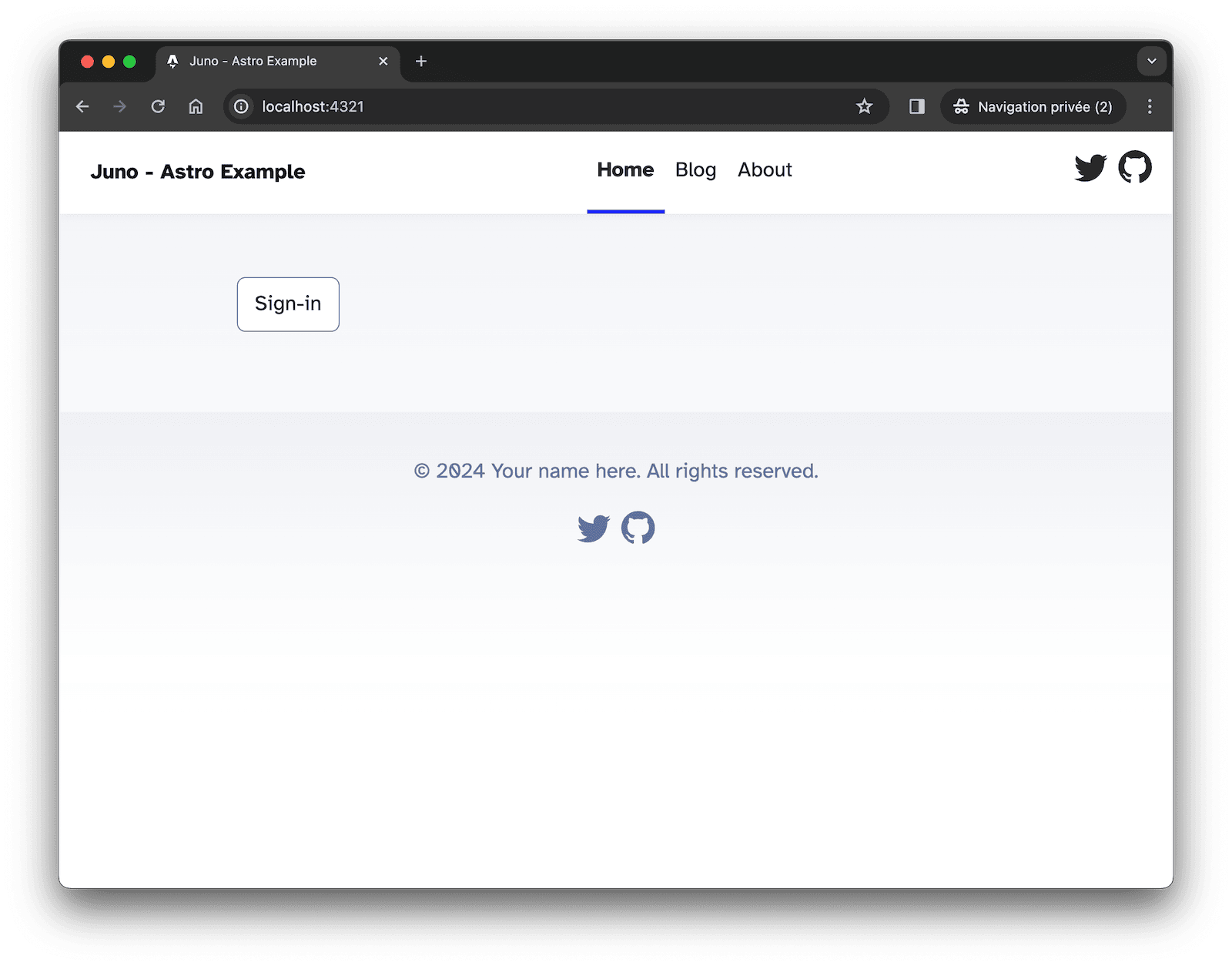
Upon visiting the site, you'll find an option to sign in using Internet Identity. Since everything is deployed locally in a sandbox, your existing identity (anchor) won't be recognized, that's why you will have to create a new one.

A screenshot that showcases the sample dApp home screen

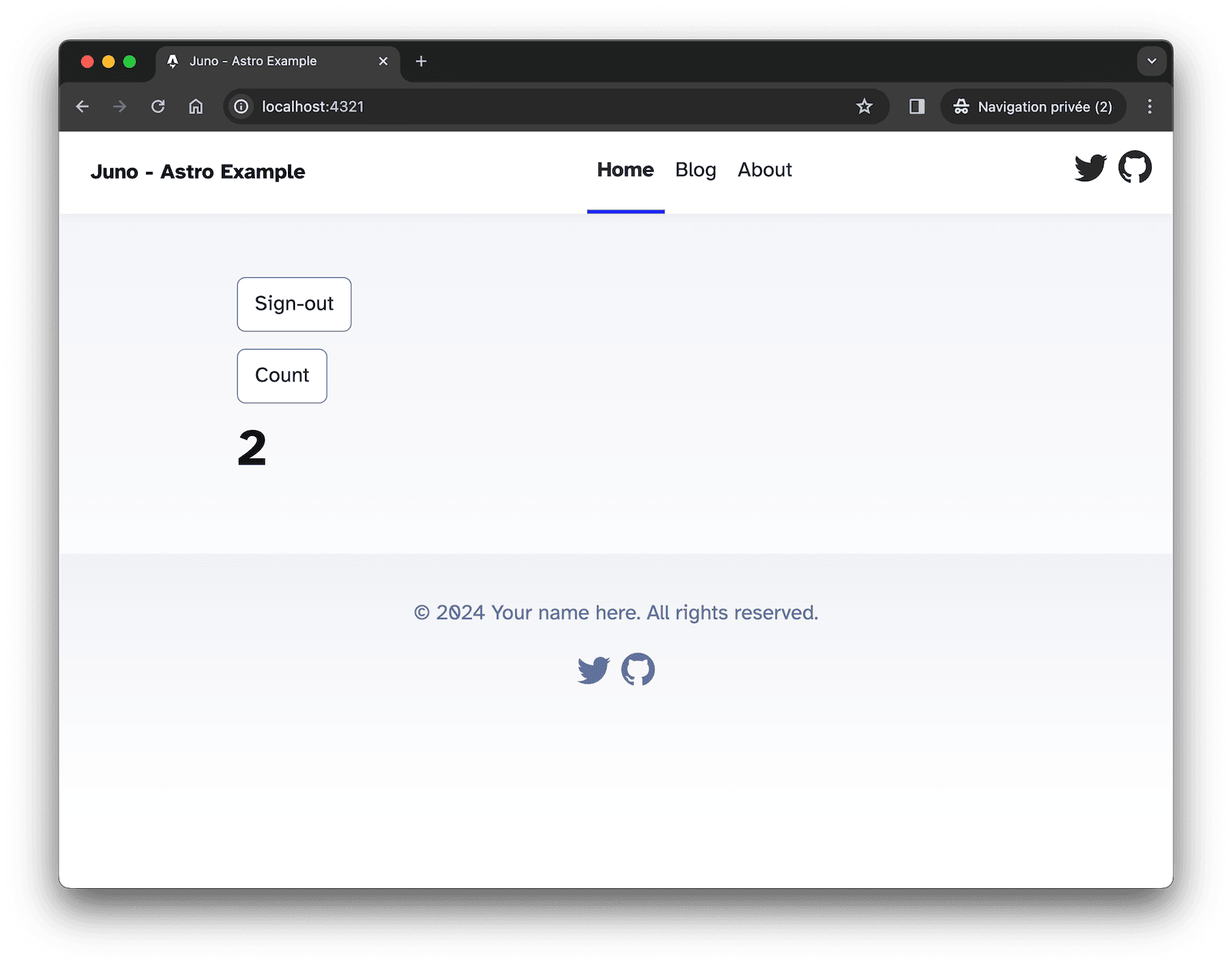
Once signed in, you'll see a "count" action, a simple feature that increments a counter and saves a value associated with your identity.

A screenshot that showcases the sample dApp once signed in

This demonstrates the dApp's capability to interact with local data and user identities.


Conclusion

In conclusion, the integration of local development capabilities with Juno, using Docker, marks a significant step forward in streamlining and simplifying the development process for dApps.

This setup not only facilitates a more efficient development cycle but also offers a practical environment for thorough testing. It's a straightforward, no-frills approach that underscores Juno's commitment to improving the developer experience without overcomplicating the process.

I am excited to see the innovative applications and solutions the developers of our community will create with these enhanced tools at their disposal.

👋


Stay connected with Juno by following us on X/Twitter.

Reach out on Discord or OpenChat for any questions.

⭐️⭐️⭐️ stars are also much appreciated: visit the GitHub repo and show your support!